Written by
Halkwinds Editorial Team
Halkwinds Research & Editorial
AI in Manufacturing: Real-World Applications
How leading manufacturers are using AI for predictive maintenance, quality inspection, scheduling optimization, and energy management — with documented ROI ranges and implementation guidance.
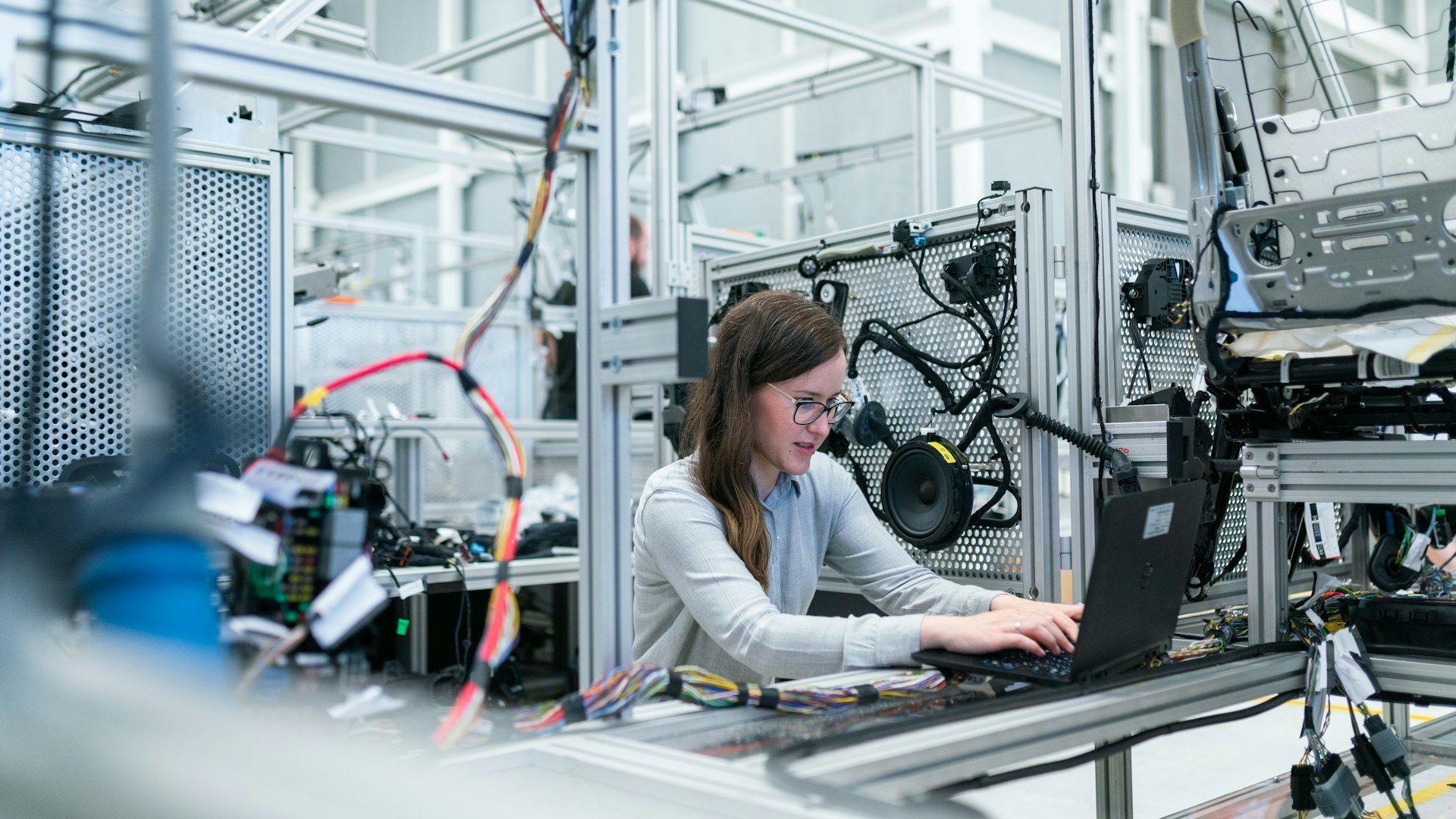
Manufacturing is experiencing its most significant productivity transformation since the introduction of computer-controlled machinery. AI is not a future projection for the sector — it is a current operational reality at leading manufacturers, delivering measurable improvements in equipment uptime, defect rates, energy consumption, and supply chain responsiveness. For operations leaders who have watched the AI wave primarily in consumer and knowledge work contexts, the manufacturing applications are arguably more mature and more immediately measurable than almost anywhere else in the enterprise.
This article examines the specific AI applications that are delivering value in production environments in 2026 — not theoretical capabilities, but documented implementations across discrete manufacturing, process industries, and hybrid production environments.
Table of Contents
- Why Manufacturing Is AI's Most Measurable Domain
- Predictive Maintenance: The Highest-ROI Starting Point
- Quality Control and Defect Detection
- Production Planning and Scheduling Optimization
- Energy Optimization
- Robotic Process Automation and Collaborative Robotics
- Supply Chain Intelligence
- Worker Safety and Ergonomics
- Implementation Roadmap
- FAQs
Key Takeaways
- Predictive maintenance delivers the fastest, most measurable ROI of any manufacturing AI application — average payback periods of 6–18 months are well-documented
- Computer vision for quality inspection has reached human-level accuracy for most defect categories and operates at speeds and consistency that human inspectors cannot match
- AI scheduling and production optimization typically delivers 8–15% throughput improvement without capital expenditure on new equipment
- The integration challenge — connecting AI systems to legacy PLCs, SCADA systems, and MES platforms — remains the most significant implementation obstacle
Why Manufacturing Is AI's Most Measurable Domain
Manufacturing environments generate dense, structured data: machine sensor telemetry, quality measurements, production counts, energy consumption, and shift-level performance data. This data richness is the foundation for AI applications — there is more high-quality historical data in a medium-sized factory than in most enterprise software deployments. Combined with the fact that manufacturing outcomes are directly measurable (units produced, defect rates, downtime hours, energy consumed), AI ROI in manufacturing is among the most directly quantifiable of any industry.
The second advantage is scale. A 1% improvement in OEE (Overall Equipment Effectiveness) on a production line running $50M of annual throughput is worth $500K. AI applications that deliver 5–10% OEE improvements — not uncommon for mature deployments — create value at a scale that justifies substantial technology investment. See how these patterns connect to broader generative AI use cases across industries and our Nexora operations platform.
Predictive Maintenance: The Highest-ROI Starting Point
Unplanned equipment downtime costs manufacturing companies an average of $260,000 per hour across industries — significantly more for capital-intensive processes like semiconductor fabrication, automotive assembly, or continuous process manufacturing. Traditional maintenance approaches (calendar-based preventive maintenance, reactive repair) are inefficient in opposite directions: preventive maintenance replaces components that still have useful life; reactive maintenance allows failures that could have been prevented.
AI-based predictive maintenance uses sensor data — vibration, temperature, pressure, acoustic signatures, power consumption — combined with machine learning models to detect anomalous patterns that precede equipment failure. The model learns what "normal" looks like for each machine across operating conditions, identifies deviations, and generates maintenance alerts with estimated time to failure and confidence intervals.
Documented Results
- Reduction in unplanned downtime: 25–45% in documented deployments
- Maintenance cost reduction: 10–25% through elimination of unnecessary preventive maintenance
- Spare parts inventory reduction: 15–30% through better failure prediction timing
- Mean Time Between Failures (MTBF) improvement: 15–30%
Implementation Requirements
Effective predictive maintenance requires sensor data at sufficient frequency (typically 1Hz or higher for mechanical components), a historian database with sufficient historical data to train failure prediction models (minimum 12 months, ideally 24+), and labeled failure events in the historical data. Edge computing infrastructure is typically required to process sensor data at the machine level without overwhelming network bandwidth.
Quality Control and Defect Detection
Computer vision for automated quality inspection is one of the most mature AI applications in manufacturing. Systems trained on image datasets of acceptable and defective parts can identify surface defects, dimensional variances, assembly errors, and contamination at inspection rates and consistency levels that human inspectors cannot match.
State-of-the-art systems in 2026 achieve:
- Defect detection accuracy exceeding 99.5% for trained defect categories
- Inspection speeds of 200–1,000 parts per minute depending on complexity
- 24/7 operation with no fatigue degradation
- Consistent application of acceptance criteria (no inspector-to-inspector variation)
- Digital record of every inspection decision (critical for regulated industries)
Beyond Defect Detection
Advanced quality AI systems have expanded beyond pass/fail defect detection to root cause analysis: correlating defect patterns with upstream process parameters (temperature, pressure, feed rate, tooling wear) to identify process drift before it creates defective output. This shift from reactive quality control to proactive process control is where the most significant quality improvement opportunities lie.
Production Planning and Scheduling Optimization
Production scheduling is one of the most computationally complex optimization problems in operations management. Traditional approaches — rule-based schedulers, manual adjustment by experienced planners — produce serviceable schedules but leave significant optimization potential on the table. AI-based scheduling systems that model machine capacity, tooling availability, material availability, shift patterns, customer priority, and changeover requirements can find schedules that rule-based systems cannot.
Documented improvements from AI scheduling deployments include 8–15% throughput improvement on existing equipment, 20–35% reduction in schedule adherence variance, and 15–25% reduction in work-in-process inventory. These improvements come without capital investment in new equipment — they are efficiency gains from better utilization of existing capacity.
Our Nexora platform includes production scheduling optimization built for complex multi-line manufacturing environments, with integration to major MES and ERP platforms. See also our AI agent operations automation guide.
Energy Optimization
Energy is a top-3 cost driver for most manufacturers. AI-based energy management systems analyze energy consumption patterns across equipment, shifts, and production variables to identify optimization opportunities: load scheduling to avoid peak-rate demand charges, predictive adjustment of HVAC and compressed air systems based on production forecasts, and anomaly detection for equipment consuming more energy than expected (often an early indicator of maintenance needs).
Manufacturing facilities that have deployed AI energy management report 8–20% reduction in energy consumption without production impact. For a facility spending $5M annually on energy, this translates to $400K–$1M in annual savings — a typical payback period of 12–24 months for the technology investment.
Supply Chain Intelligence
Manufacturing supply chains operate on planning cycles that assume stable lead times, reliable suppliers, and predictable demand. Reality is consistently different. AI supply chain applications address this by: monitoring supplier risk signals (financial health indicators, logistics disruption data, geopolitical risk) to enable proactive multi-sourcing decisions; improving demand forecasting accuracy using broader signals (leading indicators, market data, customer order patterns) beyond historical sales; and optimizing inventory positioning across distribution networks.
For manufacturing supply chain AI, see our detailed article on AI in logistics and supply chain management. Our custom AI solutions practice has built supply chain optimization systems for manufacturers across discrete and process industries.
Implementation Roadmap
A pragmatic manufacturing AI implementation sequence:
- Data infrastructure assessment (Weeks 1–4): Audit existing sensor coverage, data historian configuration, and data quality. Most factories have significant sensor data that is not being effectively collected or stored in a format suitable for AI analysis.
- Predictive maintenance pilot (Months 2–6): Select 3–5 critical assets with historical sensor data and known failure modes. Deploy predictive models and measure performance versus baseline.
- Quality inspection pilot (Months 4–9): Identify the highest-volume, highest-stakes inspection point. Deploy computer vision and run in parallel with human inspection to validate performance before replacing human inspectors.
- Scheduling optimization (Months 6–12): Integrate AI scheduling with existing MES data. Run AI recommendations in advisory mode initially, tracking recommendation quality before full deployment.
- Expand and integrate (Year 2+): Scale proven applications, integrate cross-functional data (quality, maintenance, energy, scheduling) for more sophisticated optimization.
Contact our enterprise AI team for a manufacturing AI readiness assessment, or review the AI development cost guide to understand investment requirements. Talk to us about your specific production environment.
Frequently Asked Questions
Do we need to replace our existing SCADA and MES systems to implement AI?
No. Most manufacturing AI implementations integrate with existing SCADA, MES, and ERP systems through standard industrial protocols (OPC-UA, MQTT) and APIs. The AI layer operates on data from existing systems without replacing them. The integration work is typically the most significant technical challenge, but it is achievable without replacing core operational systems.
How much historical data is needed to train effective predictive maintenance models?
For equipment with common failure modes and regular sensor data: 12–24 months of operational data provides a sufficient training foundation. For rare failure modes (equipment that fails infrequently), domain knowledge and physics-based models supplement statistical learning to compensate for limited failure event data.
What is the typical ROI timeline for manufacturing AI?
Predictive maintenance: 6–18 months to positive ROI. Quality inspection automation: 12–24 months. Scheduling optimization: 6–12 months. Energy management: 12–24 months. These ranges assume focused implementations on high-value applications — scattered, unfocused deployments without clear success metrics take much longer to demonstrate value.
How do AI quality inspection systems handle new product introductions?
New product introductions require new model training with acceptable/defective image examples of the new part. Lead time from first samples to production-ready model is typically 4–8 weeks depending on defect variety and image collection logistics. Some systems support transfer learning from similar product families, reducing training data requirements for related products.
What workforce implications does manufacturing AI have?
Quality inspection automation reduces manual inspection headcount over time, typically through attrition rather than immediate displacement. Predictive maintenance and scheduling AI requires maintenance and operations staff to work differently — responding to model alerts rather than fixed schedules. The net effect in documented deployments has been redeployment of workers from repetitive monitoring tasks to higher-value problem-solving and model oversight roles, with gradual reduction in total workforce through attrition.
Is manufacturing AI applicable to small and mid-size manufacturers?
Yes, with adjusted scope. Cloud-based AI platforms have reduced the technology cost barrier significantly. A 200-person contract manufacturer can implement AI quality inspection and predictive maintenance at a fraction of what it would have cost five years ago. The key is scoping to the highest-value application rather than attempting broad enterprise-wide AI transformation.
Explore Further