Healthcare & MedTech Industry
Transforming Healthcare Through Technology
End-to-end healthcare platforms, patient systems, telemedicine solutions, and AI-driven analytics to deliver safer, smarter, and connected healthcare experiences.
Patients Served
10M+
HIPAA/GDPR Compliance
100%

The Industry
Healthcare & MedTech
Telemedicine, EHR/EMR Platforms, Remote Patient Monitoring, Health Analytics
Transforming Modern Healthcare
We build secure, scalable, and compliant healthcare solutions that enhance patient experience, streamline clinical workflows, and improve outcomes. Our platforms support hospitals, clinics, diagnostics, and digital health startups with advanced AI, interoperability, and telemedicine capabilities.
Patients Served
HIPAA/GDPR Compliance
The Challenge
Healthcare systems must handle sensitive patient data securely while providing seamless access, interoperability, telemedicine, and intelligent decision support. The challenge lies in delivering fast, compliant, and scalable systems without compromising patient privacy.
Our Solution
We build robust healthcare platforms with HIPAA/GDPR-compliant architecture, AI-driven diagnostics, secure patient portals, telemedicine modules, and real-time monitoring tools. Our solutions ensure security, reliability, and interoperability across systems.
Our Approach
Strict HIPAA/GDPR compliant architecture
AI-driven diagnostics and analytics
Seamless patient, doctor & hospital workflows
Interoperability with HL7, FHIR, and EHR systems
Data Signals
Industry Readiness Dashboard
Quantitative KPIs, execution levers, and implementation runway built from the operating model. No stock imagery—just the numbers decision makers request.
Market KPIs
Operational snapshot
Patients Served
10M+
HIPAA/GDPR Compliance
100%
Result Metrics
Growth indicators
95%
500+
99.9%
4.8
Execution Levers
Strategic approach
- 1
Strict HIPAA/GDPR compliant architecture
- 2
AI-driven diagnostics and analytics
- 3
Seamless patient, doctor & hospital workflows
- 4
Interoperability with HL7, FHIR, and EHR systems
Delivery Phases
Implementation timeline
Discovery & Planning
3 weeksDesign & Prototyping
5 weeksDevelopment & Testing
18 weeksLaunch & Growth
OngoingSolutions
Capability matrix
Telemedicine Platforms
Secure teleconsultation systems with video calls, appointment scheduling, e-prescriptions, and digital payments.
Electronic Health Records (EHR/EMR)
Complete medical records platforms with patient management, clinical data storage, and interoperability standards.
Remote Patient Monitoring
IoT-powered health tracking, device integration, vital monitoring, and alerts for chronic disease management.
Healthcare Analytics
AI-driven predictive analytics, clinical insights, hospital operational dashboards, and patient outcome forecasting.
Use Cases
Real-world scenarios
End-to-End Hospital Platform
An integrated hospital system for patient management, doctor workflows, billing, EHR, telemedicine, and analytics.
AI-Powered Diagnostics App
A MedTech solution that analyzes symptoms, scans, and vitals to support early disease detection and patient guidance.
Tailored solution blueprints built for your operating reality
Every card below represents a pre-modeled capability with scope, governance, and measurement baked in. Swap imagery for the data points stakeholders care about—speed, coverage, and value.
Available Plays
45
Catalogued, ready-to-execute initiatives
Avg. Timeline
8-12w
Discovery to deployment
Telemedicine Platforms
Secure teleconsultation systems with video calls, appointment scheduling, e-prescriptions, and digital payments.
Electronic Health Records (EHR/EMR)
Complete medical records platforms with patient management, clinical data storage, and interoperability standards.
Remote Patient Monitoring
IoT-powered health tracking, device integration, vital monitoring, and alerts for chronic disease management.
Real-World
Use Cases
Proven Results
See how our solutions have transformed businesses in your industry, delivering measurable results and driving growth.

End-to-End Hospital Platform
An integrated hospital system for patient management, doctor workflows, billing, EHR, telemedicine, and analytics.
Key Benefits:
- Improved patient flow by 60%
- Integrated EHR with FHIR/HL7 compatibility
- Reduced admin work by 45%
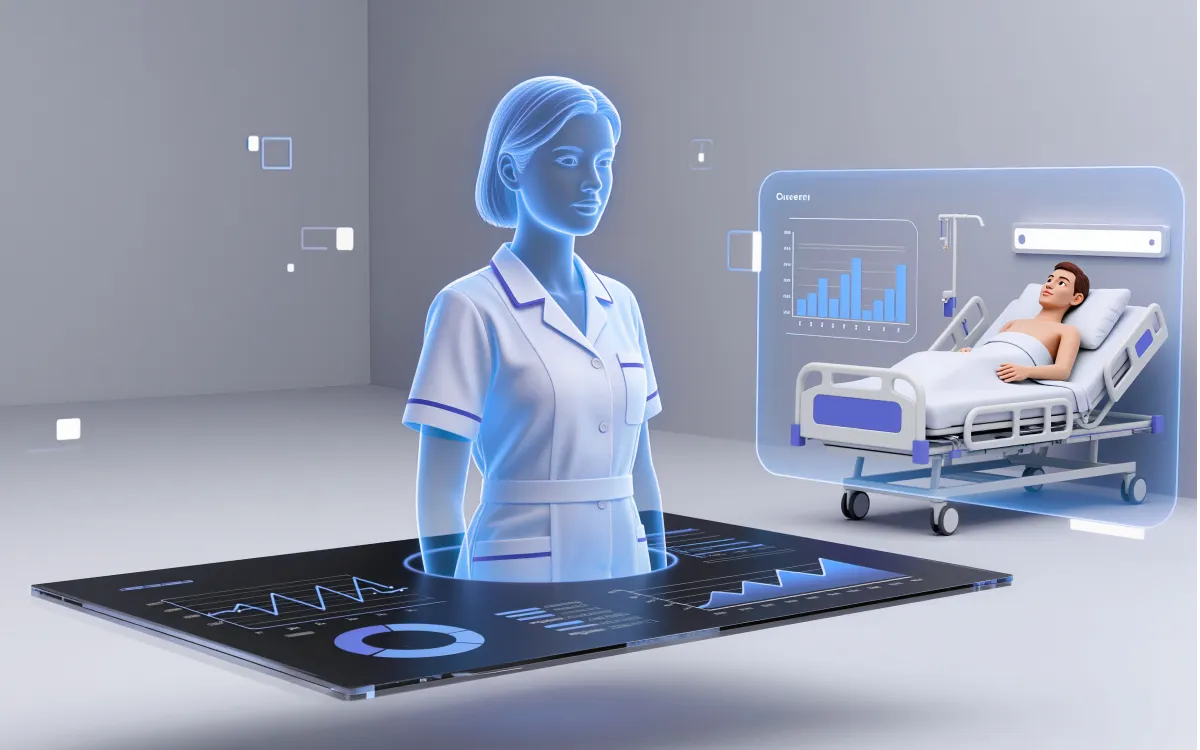
AI-Powered Diagnostics App
A MedTech solution that analyzes symptoms, scans, and vitals to support early disease detection and patient guidance.
Key Benefits:
- 25% faster diagnosis
- 80% improved prediction accuracy
- Supports multiple medical specialties
Why Choose Us
Key Benefits
Discover the advantages of working with our industry-specific solutions
Regulatory Compliance
Built with strict HIPAA, GDPR, and healthcare regulatory standards to protect patient data.
Seamless Interoperability
HL7, FHIR, and EHR integrated platforms ensuring hospital systems and devices communicate smoothly.
AI-Driven Healthcare
Predictive diagnostics, automated triage, anomaly detection, and patient outcome forecasting.
Improved Patient Experience
User-friendly apps that simplify consultations, appointments, prescriptions, and care tracking.
Technology Stack
Built with cutting-edge technologies and modern frameworks for scalability, performance, and reliability
Frontend
Backend
Mobile
Infrastructure
Tools & Services
Our Process
A systematic approach that ensured timely delivery and exceeded expectations
Discovery & Planning
- Medical workflow analysis
- Regulatory requirements mapping
- EHR/Telemedicine architecture planning
- Interoperability standards definition
Design & Prototyping
- Patient & doctor UI/UX design
- Clinical workflow prototypes
- Security-first design validation
- Device & EHR integration planning
Development & Testing
- HIPAA/GDPR-compliant backend development
- Telemedicine & EHR modules
- IoT & device integration
- Load testing & security audits
Launch & Growth
- Production deployment
- Security monitoring & audits
- Feature updates & regulatory upgrades
- User adoption & onboarding
Results & Impact
Measurable outcomes that prove the work.
Every engagement is anchored in clear KPIs. We spotlight the moves that mattered—speed, scale, reliability—and how they showed up in the business.
Client Satisfaction
Projects Delivered
Uptime
Average Rating
Key Achievements
What we shipped, what they felt.
The moments that mattered most, validated with hard numbers.
- 01✓Processed 10 million+ patient profilesImpact Verified
- 02✓Integrated 500+ hospitals & clinicsImpact Verified
- 03✓Achieved zero security breachesImpact Verified
- 04✓Improved diagnosis accuracy by 80% using AIImpact Verified
- 05✓Reduced patient wait times by 60%Impact Verified
Case Studies & Success Stories
We build solutions that deliver results. Here's a selection of our most impactful projects that transformed businesses.

Enhancing Athlete and Industry Connectivity through a Sports-Focused Professional Network
A leading sports industry organization needed to bridge the gap between athletes, coaches, agents, and industry professionals. The existing fragmented...

Sports
Sports

Education
Education

Education
Education

Cloud
Cloud
Featured Platform
CareAxis Health OS
The enterprise healthcare operating system we engineered — unifying clinical workflows, AI diagnostics, telemedicine, revenue cycle, and population health in one HIPAA-compliant platform.
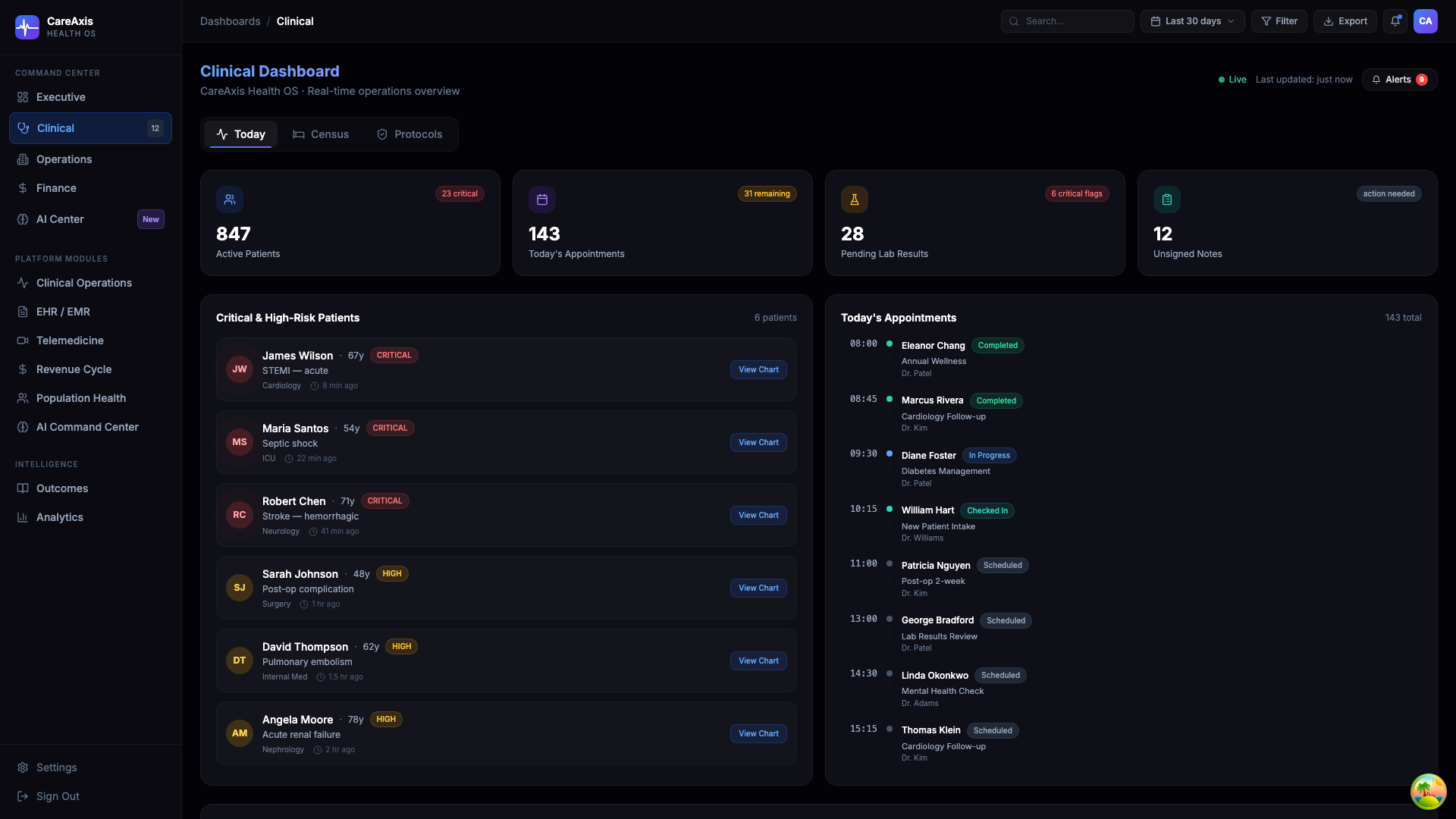
60%
IT Complexity Reduced
40%
Admin Time Saved
28%
Collections Improved
CareAxis consolidates clinical operations, AI-powered diagnostics, telemedicine, revenue cycle management, and population health into a single platform — eliminating fragmented point solutions and giving leadership a unified operational view.
Healthcare
Healthcare Software Services
Telemedicine App Development
Real-time video visits, remote patient monitoring, and EHR-integrated scheduling.
EHR Software Development
Interoperable electronic health records built for cross-provider care coordination.
EMR Software Development
Custom electronic medical record systems built for a single practice or clinic.
Healthcare AI Solutions
Clinical decision support, ambient documentation, and risk AI built on this same software foundation.
AI Development
Production AI systems for diagnostics and care pathway prediction.
Related Solutions
Explore Related Services
Healthcare Software Development
HIPAA-compliant clinical systems, patient portals, and EHR integrations built on HL7 FHIR standards.
Healthcare AI Solutions
Clinical decision support, ambient documentation AI, and predictive patient risk modelling for health systems.
AI Development
Production ML systems for diagnostics, readmission prediction, care gap identification, and documentation automation.
Machine Learning Development
Clinical ML pipelines — sepsis prediction, radiology AI, CDI automation, and patient risk stratification.
Blockchain Development
Permissioned networks for pharmaceutical provenance, clinical trial integrity, and patient consent management.
Custom Software Development
Bespoke healthcare applications — from practice management to population health platforms and clinical analytics.
Related Industries & Pillars
AI & ML Engineering
Clinical AI systems for documentation automation, diagnostic support, predictive risk modelling, and care pathway optimisation.
Blockchain Engineering
Permissioned blockchain for pharmaceutical supply chain provenance, clinical trial integrity, and patient consent management.
Financial Services
Healthcare revenue cycle, payment infrastructure, and compliance systems sharing architecture patterns with financial operations.
Related Industries & Pillars
Technologies
Healthcare Solutions
- Free AI Readiness AssessmentAI maturity score + 12-month roadmap
- Free Cloud Cost AuditFind 20–40% cloud waste in 5–7 days
- Build vs Buy Healthcare SoftwareMake-or-buy decision guide
- Custom EHR vs Off-the-ShelfEHR selection framework
- Telemedicine vs In-Person TechDigital health investment guide
- Healthcare App Development CostReal pricing and cost guide
- EHR Development CostCustom EHR pricing guide
- Telemedicine Platform CostTelehealth build pricing
- Client Case StudiesReal-world project outcomes
- Insights & ArticlesTechnical depth and strategy
- Start a ProjectScope your engagement
Built for Every Stage of Growth
For HealthTech Startups
HIPAA-compliant from day one — without slowing you down.
Launch a clinical product in 8–12 weeks. Our templates handle HIPAA, HL7 FHIR, and EHR integrations so you focus on the clinical problem, not compliance plumbing. Used by pre-seed through Series B companies.
Book Free AI Assessment →HIPAA-compliant MVP in 8–12 weeks
HL7 FHIR & EHR integrations ready
Clinical AI features from day one
Enterprise-grade quality. Startup-friendly timelines and investment.
Research & Market Intelligence
Healthcare Research Reports
Enterprise AI Adoption Trends 2026
Enterprise AI has crossed the operational threshold. Seventy-two percent of Fortune 500 organizations now run at least one AI system in production — and the average enterprise manages 3.4 concurrent AI initiatives. This report maps the state of enterprise AI across healthcare, manufacturing, financial services, retail, and beyond.
Read reportHealthcare AI Trends 2026
Healthcare AI is the fastest-growing sector in enterprise AI investment, projected to grow from $45.2B (2025) to $187.4B by 2030. This report examines clinical AI maturity, administrative automation ROI, and the emerging regulatory frameworks that will define healthcare AI deployment strategy through 2028.
Read reportSaaS Development Benchmarks 2026
What does it actually cost to build and scale a SaaS product in 2026? This report benchmarks engineering team size, deployment frequency, infrastructure spend, and time-to-market across 521 SaaS companies — from $1M ARR seed-stage startups to $100M+ enterprise SaaS leaders.
Read reportAI Agent Adoption Report 2026
AI agents are the most transformative enterprise technology category of the 2025–2026 cycle. This dedicated report examines architecture patterns, deployment economics, governance approaches, and the emerging multi-agent production landscape across 634 organizations — the most comprehensive agent-specific enterprise research available.
Read reportImplementation Cost Guides
Healthcare Development Cost Guides
Transparent pricing breakdowns to help you plan and budget your healthcare technology investments.
Healthcare App Development Cost
HIPAA-compliant health app pricing
EHR Development Cost
Custom EHR system pricing guide
Telemedicine Platform Cost
Telehealth platform cost breakdown
AI Development Cost
Medical AI & ML system pricing
AI Agent Development Cost
Healthcare AI agent build pricing
Healthcare AI Development Cost
Clinical AI and diagnostic model pricing, HIPAA and EHR integration included
Cloud Migration Cost
HIPAA-compliant cloud migration pricing
Clinical Decision Support System Cost
CDS model, EHR integration, and clinical validation pricing
Healthcare Data Integration Cost
FHIR, HL7, and EHR interface pricing
Medical Device Software Cost
FDA-ready, IEC 62304-compliant build pricing
Patient Portal Development Cost
HIPAA-compliant patient portal pricing
Remote Patient Monitoring Cost
RPM platform and device integration pricing
Technology Decisions
Healthcare Technology Decision Guides
Side-by-side decision frameworks to help healthcare teams choose the right technology approach.
Build vs Buy Healthcare Software
Make-or-buy decision guide for health systems
Custom EHR vs Off-the-Shelf EHR
EHR selection framework for clinical teams
Telemedicine vs In-Person Care Tech
Digital health investment guide
Custom AI vs Off-the-Shelf AI
Healthcare AI build vs buy guide
RAG vs Fine-Tuning
AI approach decision guide for health data
Custom Software vs SaaS
Build or buy for healthcare platforms
AI Diagnostics vs Traditional Diagnostics
Clinical AI approach decision guide
FHIR vs HL7
Health data interoperability standard decision
Case Studies & Success Stories
Healthcare Success Stories
Reference builds and client projects with measurable outcomes in healthcare. Platform demos are labelled as such; client projects are labelled separately.
Multi-Clinic Coordination Platform
HIPAA-compliant care coordination across a fragmented regional health network
47
Clinics Unified
Patient Communication System
Intelligent patient outreach that recovered $2.1M in annual revenue
41%
Reduction in No-Show Rate
Telehealth Operations Platform
40x telehealth volume growth through operational automation and workflow intelligence
40×
Visit Volume Scale
Healthcare Compliance Dashboard
Continuous compliance monitoring replacing 6 departmental silos
100%
Audit Readiness at Accreditation
Clinical Prior-Authorization Automation
AI agents assembling clinical evidence and predicting approval likelihood before submission
6d → <24h
Average Prior-Auth Turnaround
Payer Claims Analytics & Fraud Triage
AI agents scoring and routing high-risk claims before payment, not after
$6M
Annual Fraud Payout Reduction
Deep-Dive Resources
Explore Healthcare AI In Depth
Comprehensive guides, ROI benchmarks, compliance frameworks, and automation roadmaps — everything you need to plan and execute your healthcare AI transformation.
Artificial Intelligence
Healthcare AI Use Cases
Discover how AI is transforming operations, reducing costs, and creating competitive advantages in your industry.
ExplorePricing & Budgets
Healthcare Cost Guide
Complete pricing breakdown for AI and technology implementation — from discovery to deployment.
ExploreProcess Automation
Healthcare Automation
Identify the highest-ROI automation opportunities and build a phased implementation roadmap.
ExploreRegulatory Compliance
Healthcare Compliance
Navigate regulatory requirements with a compliance architecture designed for AI systems.
ExploreReturn on Investment
Healthcare ROI & Business Impact
Benchmarks and financial models for measuring the business impact of AI investments.
ExploreIndustry Challenges
Healthcare Challenges & Solutions
The most common AI adoption barriers and proven strategies to overcome them.
ExploreSuccess Stories
Healthcare Case Studies
Real implementations with verified outcomes — the proof behind the potential.
ExploreDownloads & Decision Support
Healthcare Executive Resources
Practitioner-grade checklists and evaluation frameworks you can use before, not after, you talk to a vendor.
Enterprise Trust
Healthcare Compliance & Security Architecture
Built for the scrutiny of enterprise security reviews, legal teams, and compliance officers.
Compliance Frameworks & Standards
Federal law requiring administrative, physical, and technical safeguards for all protected health information (PHI). Applies to covered entities and business associates.
Strengthens HIPAA with breach notification requirements, increased penalties up to $1.9M per violation category, and expanded business associate obligations.
Governs electronic records and signatures for FDA-regulated activities. Critical for pharmaceutical AI, clinical trial systems, and regulated medical device software.
Interoperability standard mandated by CMS for EHR data access. Ensures patient data portability and API-based data exchange.
Security attestation covering availability, processing integrity, confidentiality, and privacy. Required by most hospital enterprise procurement processes.
Built-in Security Practices
NDA & IP Assignment on Day 1
Every engagement starts with a mutual NDA and full IP assignment to the client. Your code, data, and intellectual property remain yours exclusively.
Secure Development Lifecycle
SAST (static analysis), DAST (dynamic scanning), and dependency audits run automatically in CI/CD. Vulnerabilities are triaged before any PR merges to main.
Encryption at Rest & in Transit
All data encrypted with AES-256 at rest and TLS 1.3 in transit. Secrets managed via AWS Secrets Manager, Azure Key Vault, or HashiCorp Vault — never in code.
Role-Based Access & Audit Logs
Least-privilege IAM across all environments. Every access event is logged, retained, and available for your security audits — cloud-native audit trails by default.
Infrastructure Security
Private VPCs, no public-facing databases, WAF on all API gateways, DDoS mitigation via CloudFront/Azure Front Door. Security groups reviewed on every infrastructure change.
Vulnerability Disclosure Process
A documented responsible disclosure programme and defined SLAs for critical findings: Critical (4 hrs), High (24 hrs), Medium (72 hrs). Quarterly penetration testing available.
Security review required by your procurement team?
We maintain a security questionnaire response pack, architecture diagrams, and vendor due-diligence documentation ready to send within 24 hours.
Testimonials
Reviews
That Speak Volumes
Hear how our technology solutions have transformed operations, accelerated growth, and delivered measurable results for businesses across industries.improved efficiency, and driven growth.
"Our partnership with Halkwinds is one of our biggest and most important strategic partnership we have and we are really happy to continue working with halkwinds team going forward. Halkwinds has been a very important part of hitracts development and growth, they are skilled, fast in delivery, creative and solution-oriented which makes them a super partner in driving our business forward."

Robel Dawit
Founder & CEO, Hitract
"Without a doubt, Halkwinds is one of our most critical strategic partnerships. Their speed, creativity, and solution-oriented approach have been crucial for BundlerSolution's development. Their skilled team consistently delivers, making them a super partner to drive our business forward. We're excited to continue this mutually beneficial collaboration"

David Wester
Founder & CEO, BundlerSolution
"What I admire the most from the halkwinds team is no matter how pressured you are, I still find everyone smiling and enjoying what they do. Not just project manager, I would like to thank the entire team for all the efforts throughout the project."

Tor O. Ahlgren
Founder, S2S
Research Library
Related Research Reports
AI Agent Adoption Report 2026
AI agents are the most transformative enterprise technology category of the 2025–2026 cycle. This dedicated report examines architecture patterns, deployment economics, governance approaches, and the emerging multi-agent production landscape across 634 organizations — the most comprehensive agent-specific enterprise research available.
Read reportSoftware Engineering Productivity Benchmark Report 2026
Every engineering organization now tracks some form of productivity metric, and nearly all of them are experimenting with AI-assisted development — yet the relationship between AI adoption, developer experience, and actual delivery performance is far messier than headline productivity claims suggest. This report benchmarks DORA and SPACE metrics, AI coding assistant ROI, developer experience investment, and enterprise delivery performance across 758 engineering organizations, and maps what separates teams that convert AI tooling into measurable throughput from teams that convert it into more code review debt.
Read reportSaaS Development Benchmarks 2026
What does it actually cost to build and scale a SaaS product in 2026? This report benchmarks engineering team size, deployment frequency, infrastructure spend, and time-to-market across 521 SaaS companies — from $1M ARR seed-stage startups to $100M+ enterprise SaaS leaders.
Read reportEnterprise Cloud Cost Benchmark Report 2026
Enterprise cloud spend reached $780 billion globally in 2025 — yet 32% remains unoptimised waste according to our benchmark data. This report quantifies cloud cost maturity across AWS, Azure, and GCP, mapping FinOps practice adoption, reserved capacity utilisation, and savings plan optimisation against peer benchmarks.
Read reportIndustry Intelligence
Industry Resources
Healthcare
End-to-end healthcare platforms, patient systems, telemedicine solutions, and AI-driven analytics to deliver safer, smar
Explore industry Industry OverviewFinance
Cutting-edge fintech solutions that ensure security, compliance, and exceptional user experiences for financial institut
Explore industry Industry OverviewManufacturing
Advanced manufacturing solutions that optimize production, improve quality, and enable Industry 4.0 transformation.
Explore industry Artificial IntelligenceHealthcare — AI Use Cases
Read guide Return on InvestmentHealthcare — ROI & Business Impact
Read guide Industry ChallengesHealthcare — Challenges & Solutions
Read guide Pricing & BudgetsHealthcare — Cost Guide
Read guide Process AutomationHealthcare — Automation
Read guideHalkwinds Services
Related Services
Consulting
Strategic technology consulting to help your business make informed decisions about IT infrastructure, digital
Learn more ServiceApplication
Custom application development services that create scalable, responsive, and user-friendly software solutions
Learn more ServiceEngineering
End-to-end engineering services from concept to deployment, creating scalable software solutions and robust te
Learn moreBudget Planning
Related Cost Guides
Technology Decisions
Related Technology Comparisons
AI Copilot vs AI Agent: Which Should You Build in 2026?
Start with a copilot in almost every enterprise context. It's faster to build, lower-risk, easier to get organizational buy-in, and serves a
Read comparison ComparisonClaude vs GPT for Enterprise: The Deployment and Compliance Decision
Claude leads on safety, long-context reasoning, and instruction precision. GPT leads on ecosystem breadth, multimodal capability, and fine-t
Read comparisonApplied Research
Related Case Studies

FAQ
Common Questions
Most engagements range from $15,000 for a focused telemedicine or patient app to $120,000+ for a full EHR platform or hospital-wide system. Cost depends primarily on compliance scope (HIPAA/GDPR), interoperability requirements (HL7/FHIR), and how many clinical workflows need to be digitized.
Yes. Every healthcare engagement is built with HIPAA and GDPR requirements modeled into the architecture from day one — encryption at rest and in transit, audit logging, role-based access control, and BAA-ready infrastructure — not retrofitted before a compliance review.
A focused patient-facing app (telemedicine, remote monitoring) typically takes 12–16 weeks. Full hospital platforms with EHR integration, multi-role workflows, and interoperability testing range from 20–36 weeks.
Yes. We build to HL7 and FHIR interoperability standards and have integrated with Epic, Cerner, and other major EHR platforms, so new systems extend your existing clinical data rather than replacing it.
Used correctly — as a decision-support layer with a clinician in the loop, not an autonomous diagnostician — AI models can meaningfully improve early detection and reduce time-to-diagnosis. Our AI-powered diagnostics work has driven measurable gains in prediction accuracy and turnaround time while keeping a human clinician as the final decision-maker.
Yes. This is one of our core healthcare capabilities — video consultation, e-prescriptions, IoT-based vital monitoring, and chronic-disease alerting, all built on HIPAA-compliant infrastructure.
End-to-end encryption, HSM-backed key management where required, strict role-based access, and regular third-party security audits are standard on every healthcare engagement — patient data protection isn't an add-on tier.
Yes. Interoperability is designed in from the architecture phase, not bolted on afterward, so your systems can exchange data with other hospitals, labs, and payer systems without custom one-off integrations.
Both. Engagement structure differs — startups typically start with a focused MVP, while hospital systems involve more upfront compliance and integration architecture — but the same senior engineering team and security standards apply to every healthcare project.
We begin with a structured, time-boxed discovery under mutual NDA — mapping your current clinical workflows, compliance obligations, and integration points — which produces a scoped proposal, not just a conversation.
Ready to Transform Your Business Into an Enterprise-Ready Digital Leader?
We build intelligent, scalable solutions that help you evolve faster, adapt to change, and thrive in today's competitive digital landscape.