
12-06-2026
HealthcareClinical AI Engineered for Patient Outcomes, Not Proof-of-Concept Presentations
Halkwinds builds healthcare AI that integrates into clinical workflows, reduces documentation burden, improves diagnostic accuracy, and enables proactive care — HIPAA-compliant, EHR-integrated, and clinically validated before any production deployment.
Enterprise Challenges
Healthcare AI influencing clinical decisions requires rigorous prospective validation beyond standard software testing — creating liability, regulatory, and trust risk without it.
AI trained on data that underrepresents certain demographics produces systematically inferior performance for those populations — a serious health equity issue in clinical contexts.
Clinical AI that cannot integrate into Epic, Cerner, or Meditech workflows creates dual entry burdens and adoption failure regardless of model accuracy.
Clinicians working under patient outcome accountability appropriately distrust AI without confidence indicators, supporting evidence, and audit trails for every output.
AI systems meeting FDA Software as a Medical Device criteria require predicate identification and 510(k) documentation — a pathway that must be identified before development begins.
Clinical data arrives fragmented across inpatient, outpatient, lab, and pharmacy systems in inconsistent coding standards. Model accuracy is directly bounded by data quality.
What We Deliver
Evidence-based AI alerts, risk scoring, and protocol guidance integrated into EHR workflows — delivering decision intelligence at the point of care without creating alert fatigue.
Systems capturing physician-patient conversations and generating structured EHR-compatible clinical notes for physician review — reducing documentation from hours to minutes per shift.
Sepsis early warning, readmission risk scoring, and deterioration prediction trained on your patient population data and integrated with existing monitoring systems.
Computer vision systems for radiology, pathology, and dermatology — screening and detection automation integrated into PACS workflows with radiologist review queues.
Clinical NLP extracting structured information from physician notes, discharge summaries, and operative reports — converting unstructured clinical text into coded, queryable data.
AI-powered risk stratification, care gap identification, and intervention prioritisation across attributed patient populations for value-based care performance.
AI systems automating PA determination, documentation compilation, and payer submission — reducing administrative burden while improving approval rates.
ML systems identifying billing anomalies, coding irregularities, and utilisation outliers across claims and clinical data for revenue integrity protection.
Retrieval-augmented generation grounding clinical guidelines, drug interaction data, and institutional protocols in your own knowledge base — built on Pinecone, Weaviate, or pgvector with LangChain/LlamaIndex orchestration, deployable inside your HIPAA-compliant environment.
HIPAA-compliant conversational AI for symptom triage, appointment scheduling, and post-discharge follow-up — built on OpenAI and Anthropic Claude models with clear escalation paths to clinical staff, never positioned to replace clinical judgment.
Analysis of wearable and home-device telemetry to flag early deterioration signals for chronic disease and post-acute care populations, integrated with care management workflows and EHR alerting.
Enterprise Use Cases
Challenge
300-bed hospital with sepsis mortality rate 4.2 points above national benchmark. Standard SIRS criteria triggering too late with excessive false alerts.
Solution
ML early warning model processing vital signs, labs, medication orders, and nursing assessments to identify risk 6 hours before clinical recognition — integrated into Epic flowsheets.
Outcome
Sepsis mortality reduced 28%. Mean time to antibiotics improved 2.1 hours. Alert fatigue reduced 61%. $4.2M reduction in length-of-stay costs.
Challenge
Community hospital radiology with 340 chest X-rays daily and 48-hour average report turnaround affecting ED throughput and inpatient transfer decisions.
Solution
AI screening model prioritising worklist by finding severity — flagging pneumothorax and pneumonia for immediate read — with PACS integration and structured finding pre-population.
Outcome
Critical finding turnaround reduced from 4.2 hours to 38 minutes. Report turnaround reduced 41%. Zero critical finding missed in 18 months.
Challenge
Multispecialty practice with 280 physicians averaging 2.3 hours daily on EHR documentation — primary driver of burnout and limited patient panel capacity.
Solution
Ambient documentation system capturing encounter audio, generating structured SOAP notes with ICD-10 coding suggestions for physician review and sign-off.
Outcome
Documentation reduced from 2.3 hours to 34 minutes daily. Physician satisfaction improved 44 points. Patient panel capacity increased 14%.
Challenge
Health system with 14.8% 30-day readmission rate exceeding CMS benchmarks and generating $3.2M in annual penalties.
Solution
ML readmission risk model scoring inpatients daily using clinical, social determinants, and utilisation data — generating risk-stratified care management lists.
Outcome
Readmission rate reduced to 11.2%. CMS penalties reduced by $2.1M annually. Care management capacity redirected to highest-risk patients.
Challenge
Health system with $8.4M in annual revenue at risk from coding inaccuracies — undercoding complex cases and missing secondary diagnoses affecting DRG assignment.
Solution
AI CDI system analysing inpatient records in real time, identifying coding opportunities, and querying physicians for clarification.
Outcome
Case Mix Index improved 0.14 points. $6.2M in annually recoverable revenue identified. CDI programme ROI exceeded 8:1 in first year.
Challenge
Primary care network with 28,000 diabetic patients and 34% annual screening gap due to ophthalmology access limitations.
Solution
FDA-authorized autonomous AI retinal image grading system deployable at point-of-care, integrated with EHR ordering and result documentation.
Outcome
Screening completion improved from 66% to 91%. Sight-threatening retinopathy identified 8 months earlier on average.
Industry Applications
Sepsis prediction, readmission risk, documentation AI, CDI automation, and imaging AI — integrated with Epic and Cerner workflows and validated against hospital-specific population data.
Computer vision AI for image screening, measurement automation, and finding pre-population — integrated into PACS and LIS workflows to increase diagnostic throughput.
Ambient documentation AI, risk stratification, chronic disease management support, and population health analytics reducing administrative burden.
Suicide risk prediction, treatment response modelling, and administrative workflow automation designed for the data sensitivity requirements of behavioural health settings.
Prior authorisation automation, utilisation management AI, risk adjustment analytics, and care management prioritisation for health plan operations.
Patient stratification for trial eligibility, adverse event signal detection, real-world evidence generation, and biomarker identification.
How We Deliver
Engagement with clinical champions, CMOs, and compliance leadership to define the clinical problem, success metrics, validation requirements, and regulatory pathway before any data or architecture work begins.
Assessment of data availability, quality, completeness, and representativeness — identifying demographic coverage gaps and documentation inconsistencies for normalization.
AI model development with systematic bias evaluation across demographic subgroups — ensuring equitable performance before any clinical validation.
Prospective or retrospective clinical validation with expert review, sensitivity and specificity analysis, and clinical workflow impact assessment documented for governance review.
Technical integration with your EHR environment co-designed with end-user clinicians — AI outputs surfaced at the right decision point with appropriate context.
Phased rollout with prospective clinical outcome monitoring, model performance tracking, clinician feedback collection, and quarterly clinical performance reviews.
Why Halkwinds
An honest comparison. Every org has these four options — here's how they stack up for healthcare ai solutions.
| Dimension | Halkwinds | Large SI
(Accenture / TCS) | Freelancer
/ Agency | Build
In-House |
|---|---|---|---|---|
| Time to start | < 2 weeks | 8–16 weeks (procurement, MSA, SOW) | 1–3 days | 3–6 months to hire & onboard |
| Senior-only engineers | 5+ years minimum | Juniors on most project layers | Varies — no guarantee | Depends on hiring budget |
| Cost transparency | Fixed monthly or project price | Change orders, hidden overheads | Scope creep common | Salary + benefits + tooling + office |
| Full-stack accountability | One team, one SLA | Multiple vendors, finger-pointing risk | Single skill, no cross-discipline ownership | If team is complete |
| IP & code ownership | 100% assigned to client from day 1 | Contractually complex — review carefully | Depends on contract terms | Full ownership |
| AI & cloud-native expertise | Production LLMs, Kubernetes, multi-cloud | Available but expensive to staff | Niche — hard to find | Expensive, high attrition in AI talent |
| Scales up or down quickly | 2-week ramp up/down | Long contract commitments | But context loss on re-engagement | Headcount freezes, hiring lag |
| Compliance-ready (SOC2, HIPAA) | Security pack available on request | Certified — but costs more | Rarely documented | Requires investment in tooling + audit |
Time to start
Halkwinds
< 2 weeks
Large SI (Accenture / TCS)
8–16 weeks (procurement, MSA, SOW)
Freelancer / Agency
1–3 days
Build In-House
3–6 months to hire & onboard
Senior-only engineers
Halkwinds
5+ years minimum
Large SI (Accenture / TCS)
Juniors on most project layers
Freelancer / Agency
Varies — no guarantee
Build In-House
Depends on hiring budget
Cost transparency
Halkwinds
Fixed monthly or project price
Large SI (Accenture / TCS)
Change orders, hidden overheads
Freelancer / Agency
Scope creep common
Build In-House
Salary + benefits + tooling + office
Full-stack accountability
Halkwinds
One team, one SLA
Large SI (Accenture / TCS)
Multiple vendors, finger-pointing risk
Freelancer / Agency
Single skill, no cross-discipline ownership
Build In-House
If team is complete
IP & code ownership
Halkwinds
100% assigned to client from day 1
Large SI (Accenture / TCS)
Contractually complex — review carefully
Freelancer / Agency
Depends on contract terms
Build In-House
Full ownership
AI & cloud-native expertise
Halkwinds
Production LLMs, Kubernetes, multi-cloud
Large SI (Accenture / TCS)
Available but expensive to staff
Freelancer / Agency
Niche — hard to find
Build In-House
Expensive, high attrition in AI talent
Scales up or down quickly
Halkwinds
2-week ramp up/down
Large SI (Accenture / TCS)
Long contract commitments
Freelancer / Agency
But context loss on re-engagement
Build In-House
Headcount freezes, hiring lag
Compliance-ready (SOC2, HIPAA)
Halkwinds
Security pack available on request
Large SI (Accenture / TCS)
Certified — but costs more
Freelancer / Agency
Rarely documented
Build In-House
Requires investment in tooling + audit
Ready to see if Halkwinds is the right fit?
A 30-minute call is enough to scope your project, validate our fit, and agree on a starting point — no commitment required.
Halkwinds Research
Enterprise AI has crossed the operational threshold. Seventy-two percent of Fortune 500 organizations now run at least one AI system in production — and the average enterprise manages 3.4 concurrent AI initiatives. This report maps the state of enterprise AI across healthcare, manufacturing, financial services, retail, and beyond.
Read reportAI agents are the most transformative enterprise technology category of the 2025–2026 cycle. This dedicated report examines architecture patterns, deployment economics, governance approaches, and the emerging multi-agent production landscape across 634 organizations — the most comprehensive agent-specific enterprise research available.
Read reportHealthcare AI is the fastest-growing sector in enterprise AI investment, projected to grow from $45.2B (2025) to $187.4B by 2030. This report examines clinical AI maturity, administrative automation ROI, and the emerging regulatory frameworks that will define healthcare AI deployment strategy through 2028.
Read reportHealthcare cloud adoption has accelerated past the tipping point: 71% of hospitals and health systems now run at least one clinical workload in the cloud. This report quantifies migration velocity, HIPAA compliance posture, EHR cloud adoption, and the cost impact of healthcare-specific infrastructure requirements across AWS, Azure, and GCP healthcare clouds.
Read reportHealthcare AI has moved decisively past the proof-of-concept era. In 2026, the defining question for health system leadership is no longer whether AI delivers value in clinical and operational contexts — that question has been answered affirmatively across enough high-quality deployments to be settled — but rather how to scale individual successes into enterprise-wide capabilities without accumula...
Read reportThe medical AI market in 2026 is no longer a market of early pilots and proof-of-concept demonstrations. Across diagnostic imaging, clinical decision support, administrative automation, patient engagement, and drug discovery, AI systems are operating in production clinical and operational environments at scale. The strategic question facing health system executives, digital health investors, and t...
Read reportHalkwinds Blog
Pricing Intelligence
Transparent pricing breakdowns to help you plan and budget your technology investments.
AI & Machine Learning
AI & ML
AI & Machine Learning
Decision Intelligence
Side-by-side decision frameworks to help your team choose the right technology approach.
Hybrid wins. AI handles 70–80% of queries — FAQs, order status, routine troubleshooting — at a fraction of human cost. H
AI-augmented diagnostics — machine learning models reviewed and confirmed by trained clinicians — deliver the best combi
Deep learning CV for complex recognition, detection, and semantic understanding tasks. Traditional processing for geomet
Applied Research
Real implementations with measurable outcomes.
HIPAA-compliant care coordination across a fragmented regional health network
47
Clinics Unified
Intelligent patient outreach that recovered $2.1M in annual revenue
41%
Reduction in No-Show Rate
40x telehealth volume growth through operational automation and workflow intelligence
40×
Visit Volume Scale
Built On Our Platforms

Featured AI Healthcare Deployment
Production clinical AI delivering real-time diagnostics, risk stratification, and decision support across inpatient and ambulatory care — HIPAA-compliant and EHR-integrated.
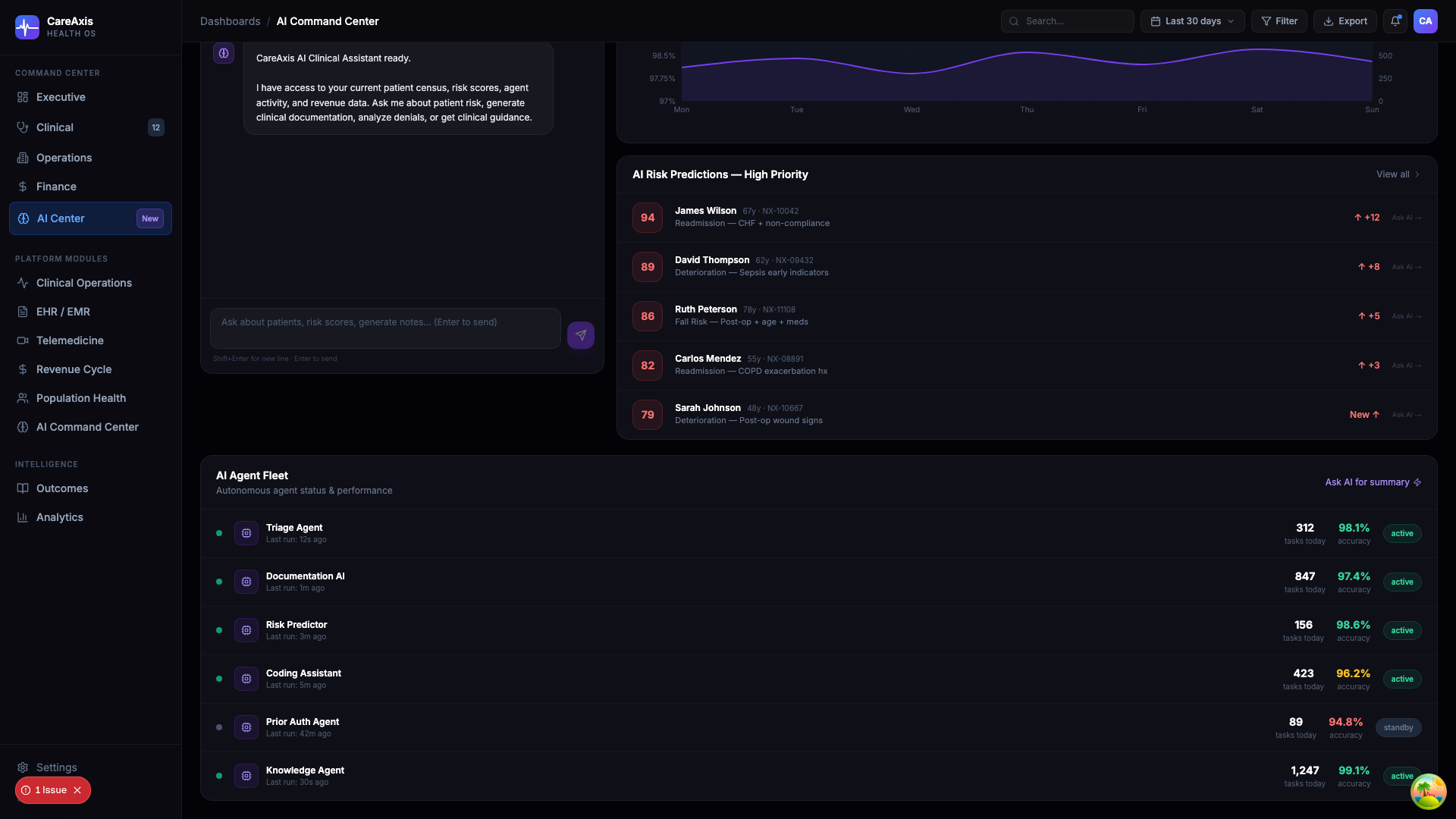
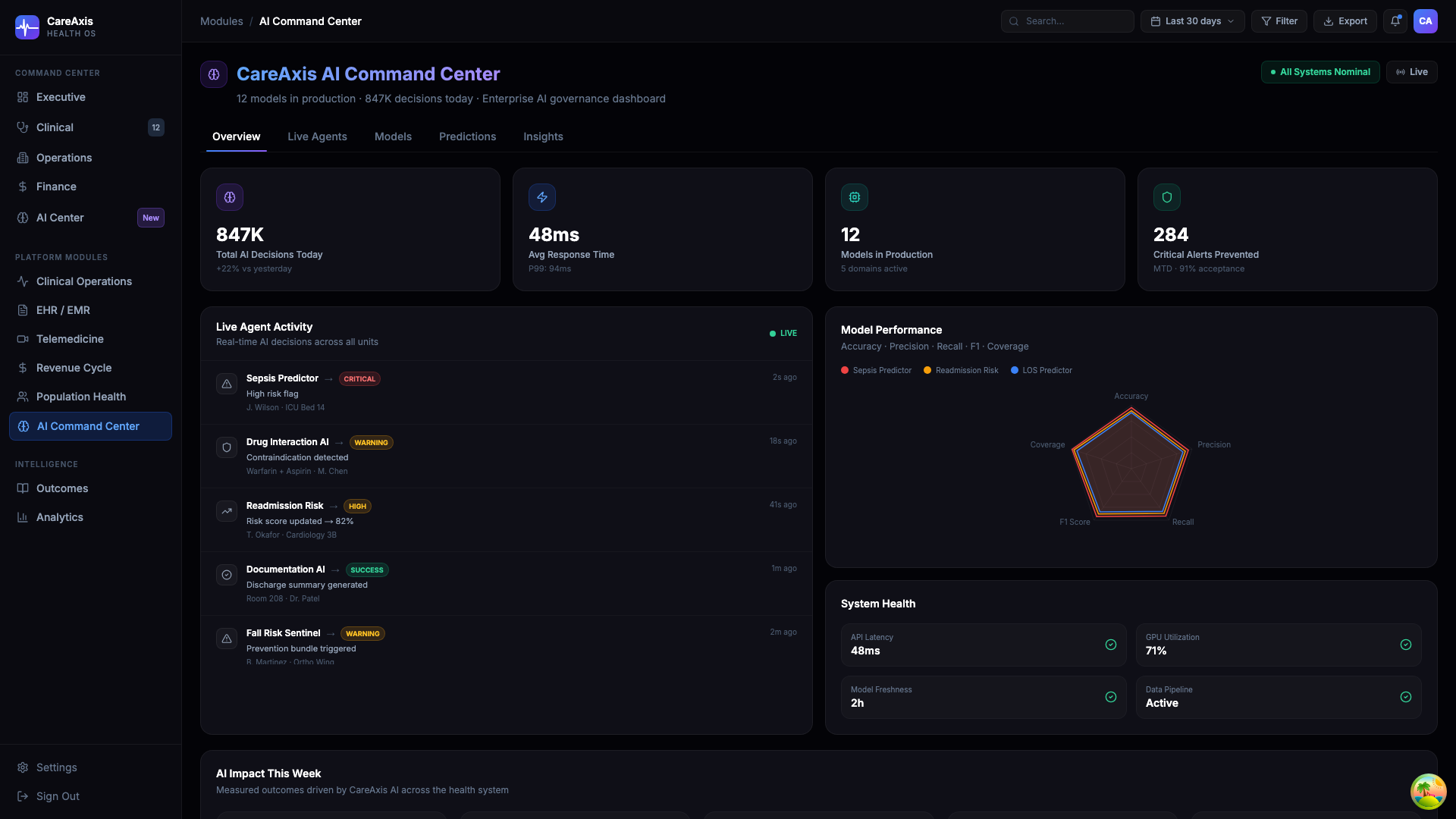
6
Clinical AI Models
<30s
Alert Latency
100%
HIPAA Compliant
0
Patient Safety Events
Related Services
HIPAA-compliant EHR-integrated clinical platforms.
Production AI infrastructure for clinical deployment.
Predictive models for patient risk and outcome forecasting.
Clinical documentation AI and medical knowledge assistants.
Fine-tuned clinical language models for specialist domains.
Prior authorisation and clinical admin workflow automation.
Retrieval-augmented generation grounding clinical guidelines and protocols in your own knowledge base.
HIPAA-compliant patient-facing chatbots for triage, scheduling, and follow-up.
Production clinical AI platform with MONAI imaging, CDS Hooks decision support, and population health intelligence.
Technologies
12 technologies · 5 categories
FAQ
Depends on the intended use. AI intended to diagnose, treat, or prevent disease may qualify as Software as a Medical Device. We conduct regulatory pathway assessment early in every engagement to identify clearance requirements before development commitments.
Clinical validation includes retrospective performance analysis on held-out patient data, subgroup performance across demographic variables, prospective shadow-mode validation, and clinical expert review — documented in a validation report before deployment authorisation.
Yes. We integrate with Epic using App Orchard APIs, CDS Hooks, SMART on FHIR, and HL7 v2 interfaces. Cerner uses similar FHIR and HL7 pathways. Timeline depends on your specific EHR environment configuration.
Bias evaluation is mandatory — measuring performance disaggregated by race, ethnicity, sex, age, and insurance status. We implement mitigation strategies including oversampling and fairness constraints for underrepresented groups.
Training data handling follows HIPAA minimum necessary standards with de-identification where feasible, data use agreements covering training purposes, access controls, and audit logging throughout the development lifecycle.
Focused clinical AI applications with available training data typically deploy in 16–24 weeks including clinical validation. Complex systems requiring prospective validation or multi-site EHR integration may require additional time.
Yes. Deployment requires physician consent protocols, audio data handling agreements, and EHR integration for note delivery into the appropriate documentation template.
Production healthcare AI requires ongoing monitoring of clinical performance metrics, model accuracy against prospective labels, demographic subgroup performance, and clinical outcome correlation.
Clinical AI typically needs to support ICD-10-CM, CPT, SNOMED CT, LOINC, and RxNorm coding standards. We build terminology mapping as part of the data pipeline rather than expecting clean coded inputs.
Healthcare AI requires clinical validation, bias evaluation across patient populations, EHR integration, HIPAA compliance, and often FDA regulatory consideration. Development timelines account for clinical validation cycles general AI does not require.
Focused clinical AI applications (a single risk model or documentation tool) typically range $150,000–$400,000 including clinical validation. Multi-site or FDA-pathway systems range higher. We scope exact cost after reviewing your data availability and regulatory pathway, not from a generic price list.
Yes — every system we build is designed as a decision-support layer, not a replacement for clinical judgment. Outputs are presented with confidence indicators and supporting evidence, and clinicians retain final authority on every decision the AI informs.
Yes, measurably — ambient documentation, prior authorisation automation, and CDI systems we've built have reduced documentation time by up to 78% and recovered millions in previously-missed revenue. We size the realistic administrative-cost impact during discovery against your own volume and staffing data.
Both — a single-specialty practice typically starts with one focused tool (e.g. ambient documentation); a health system engagement usually spans multiple sites and a full clinical validation programme. Engineering discipline and compliance standards are identical at either scale.
Every engagement is covered by mutual NDA before we discuss your specific clinical workflows or request any data access. Discovery itself typically works from de-identified samples and architecture documentation, not full PHI access, until a scoped agreement is in place.
Yes — every engagement is built to HIPAA technical safeguards (encryption, access controls, audit logging, minimum-necessary access) from the architecture phase, with BAA-compliant cloud infrastructure — AWS HealthLake for FHIR-native data storage, Azure Health Data Services, or Google Cloud Healthcare API — and compliance documentation delivered as part of the engagement.
Patient data is encrypted in transit and at rest, access is scoped per engineer on a need-to-know basis, and every access event is logged and auditable. Security posture is validated through penetration testing and HIPAA security assessment before production deployment.
Work With Halkwinds
Halkwinds delivers healthcare AI with embedded clinical validation, EHR integration, and bias evaluation — designed for the regulatory environment healthcare organisations operate under.
Architecture. Engineering. Scale. — Built by Halkwinds Product Engineering.