Healthcare Software Development Company
HIPAA-Compliant Clinical Systems Built for Healthcare Operations at Scale
Halkwinds develops healthcare software engineered for the clinical, operational, and compliance requirements of health systems, ambulatory networks, and health technology companies — with HIPAA compliance, HL7 FHIR integration, and EHR connectivity from the first architecture decision.
Enterprise Challenges
Challenges We Solve
EHR Integration Complexity
Integrating with Epic, Cerner, Meditech, and Allscripts requires deep knowledge of HL7 v2, FHIR R4, and vendor-specific APIs. Most vendors underestimate complexity, creating technical debt.
HIPAA Compliance Throughout Development
HIPAA compliance requires privacy and security controls embedded in architecture, development practices, deployment configuration, and operational procedures from day one — not retrofitted at audit time.
Clinical Workflow Disruption
Healthcare software that disrupts established clinical workflows encounters strong adoption resistance from physicians and nurses — failing to deliver projected efficiency improvements despite technical correctness.
Interoperability Across Fragmented Care Settings
Patient care spans hospitals, clinics, labs, and pharmacies — each on different systems with different data formats. Building coordination across this fragmented estate requires sophisticated integration architecture.
Healthcare Data Quality and Normalisation
Clinical data arrives in inconsistent formats, coding standards, and terminologies. Software depending on data quality without normalisation and validation layers produces unreliable outputs clinicians cannot trust.
Clinical Validation and Regulatory Review
Healthcare software in clinical decision support domains requires structured clinical validation. Development timelines that do not account for validation cycles routinely miss projected go-live dates.
What We Deliver
Core Capabilities
EHR Integration and HL7 FHIR
Deep EHR integration using HL7 v2, FHIR R4, and vendor APIs for Epic, Cerner, Meditech, and Allscripts — bidirectional data exchange eliminating dual entry.
HIPAA-Compliant Architecture
End-to-end PHI protection through encryption, role-based access controls, audit logging, minimum necessary access, and BAA-compliant deployment.
Patient Portal and Engagement Platform
Secure patient-facing platforms covering scheduling, messaging, care plan access, results delivery, and prescription management — accessible and compliant.
Revenue Cycle Management Software
Claims submission, eligibility verification, denial management, payment posting, and reporting automation integrated with EHR clinical documentation and payer APIs.
Clinical Decision Support Systems
Evidence-based clinical alerts, order set optimisation, protocol guidance, and contraindication checking integrated into EHR workflows at the point of care.
Telehealth Platform Development
HIPAA-compliant video consultation platforms with scheduling integration, EHR documentation, and insurance eligibility verification built in.
Population Health Management Software
Risk stratification platforms, care gap identification, outreach automation, and outcome tracking for value-based care contract performance.
Healthcare Data Platform Engineering
FHIR-native data repositories, clinical data warehouse architecture, and real-world evidence infrastructure converting fragmented clinical data into actionable intelligence.
Enterprise Use Cases
In Production
Patient Engagement for Multi-Site Network
Challenge
Regional health network with 28 ambulatory sites operating on four EHR systems, zero digital patient communication, and 42,000 monthly phone calls for appointment management.
Solution
Unified patient engagement platform with online scheduling, appointment reminders, care gap notifications, secure messaging, and results delivery — integrated with all four EHR systems via HL7.
Outcome
Online scheduling adoption reached 67% within 6 months. Phone call volume reduced 38%. Patient satisfaction improved 22 points. No-show rate reduced from 18% to 9%.
Revenue Cycle Automation
Challenge
300-physician multispecialty group with 34-day average revenue cycle, 18% claim denial rate, and $2.8M in accounts receivable over 90 days.
Solution
Automated eligibility verification, AI-assisted coding validation, payer-specific claim scrubbing, and denial management workflow with root cause analytics.
Outcome
Revenue cycle reduced to 19 days. Denial rate reduced to 7.4%. AR over 90 days reduced to $0.9M. $1.6M annual revenue improvement from recovered denials.
Care Coordination for ACO
Challenge
ACO managing 85,000 attributed lives across 340 providers with no integrated care coordination, producing fragmented care plans and preventable high-cost utilisation.
Solution
Care coordination platform with risk-stratified patient lists, shared care plans, automated care gap outreach, and real-time attribution analytics.
Outcome
High-risk patient outreach improved from 31% to 78%. Preventable readmission rate reduced 24%. ACO shared savings performance improved materially.
Telehealth for Behavioural Health
Challenge
Behavioural health provider needing HIPAA-compliant telehealth with group therapy session support and EHR integration not available in commercial platforms.
Solution
Custom HIPAA-compliant telehealth platform with individual and group sessions, EHR documentation integration, consent management, and crisis escalation workflow.
Outcome
Geographic service area expanded 3.2x. 34% of appointments delivered via telehealth. Patient satisfaction scores equivalent to in-person benchmarks.
Clinical Trial Management
Challenge
Academic medical centre managing 140 concurrent clinical trials on spreadsheets with regulatory compliance gaps and data integrity risks.
Solution
Custom CTMS covering protocol management, patient enrolment tracking, adverse event reporting, IRB documentation, and data collection with 21 CFR Part 11-compliant audit trails.
Outcome
Protocol deviation rate reduced 44%. Regulatory submission preparation reduced 61%. Zero FDA audit findings related to documentation.
Healthcare Data Warehouse
Challenge
298-bed health system with clinical data in 7 systems, financial data in 3, and operational data in 4 — generating reports requiring 120 analyst-hours of manual aggregation monthly.
Solution
FHIR-native data warehouse integrating all source systems with standardised clinical terminologies, automated ETL, governance framework, and self-service analytics.
Outcome
Monthly report generation automated. Analytics query time reduced from hours to minutes. $1.4M annual analytics staffing cost reduction.
Industry Applications
Across Sectors
Acute Care Hospitals
Clinical workflow systems, patient tracking, care coordination, and operational analytics — integrated with Epic and Cerner and engineered to hospital-grade uptime requirements.
Ambulatory and Multispecialty Practices
Practice management software, patient engagement platforms, revenue cycle automation, and clinical decision support reducing administrative burden.
Health Insurance and Managed Care
Member portal development, prior authorisation automation, care management platforms, and claims analytics with CMS interoperability rule compliance.
Pharmaceutical and Life Sciences
Clinical trial management, regulatory submission platforms, real-world evidence infrastructure, and medical affairs systems meeting 21 CFR Part 11 requirements.
Home Health and Long-Term Care
Care coordination platforms, remote patient monitoring, mobile clinical documentation, and outcome tracking for distributed care delivery settings.
Digital Health and Health Technology
Health technology product development from MVP through enterprise scale — with HIPAA architecture, EHR integration, and enterprise security posture.
How We Deliver
Delivery Process
Clinical and Compliance Discovery
Structured discovery with clinical stakeholders, IT leadership, and compliance teams — documenting workflow requirements, EHR constraints, HIPAA obligations, and success metrics.
HIPAA-Compliant Architecture Design
System architecture with embedded HIPAA technical safeguards — encryption, access controls, audit logging, transmission security — and integration architecture for your EHR environment.
EHR Integration Development
Development and testing of HL7 FHIR and v2 connections to your EHR — coordinating with EHR vendor technical teams on sandbox access, interface specifications, and certification.
Clinical Workflow Development and UAT
Feature development with clinical user involvement at every sprint review — validating workflow designs match real clinical work patterns and iterating based on end-user feedback.
Clinical Validation and Security Review
Clinical validation for decision support functionality, penetration testing, HIPAA security assessment, and disaster recovery validation before production deployment.
Go-Live Support and Optimisation
Phased production rollout with at-elbow clinical staff support, accelerated issue resolution SLAs, performance monitoring, and structured post-implementation review.
Why Halkwinds
Halkwinds vs. Your Other Options
An honest comparison. Every org has these four options — here's how they stack up for healthcare software development company.
| Dimension | Halkwinds | Large SI
(Accenture / TCS) | Freelancer
/ Agency | Build
In-House |
|---|---|---|---|---|
| Time to start | < 2 weeks | 8–16 weeks (procurement, MSA, SOW) | 1–3 days | 3–6 months to hire & onboard |
| Senior-only engineers | 5+ years minimum | Juniors on most project layers | Varies — no guarantee | Depends on hiring budget |
| Cost transparency | Fixed monthly or project price | Change orders, hidden overheads | Scope creep common | Salary + benefits + tooling + office |
| Full-stack accountability | One team, one SLA | Multiple vendors, finger-pointing risk | Single skill, no cross-discipline ownership | If team is complete |
| IP & code ownership | 100% assigned to client from day 1 | Contractually complex — review carefully | Depends on contract terms | Full ownership |
| AI & cloud-native expertise | Production LLMs, Kubernetes, multi-cloud | Available but expensive to staff | Niche — hard to find | Expensive, high attrition in AI talent |
| Scales up or down quickly | 2-week ramp up/down | Long contract commitments | But context loss on re-engagement | Headcount freezes, hiring lag |
| Compliance-ready (SOC2, HIPAA) | Security pack available on request | Certified — but costs more | Rarely documented | Requires investment in tooling + audit |
Time to start
Halkwinds
< 2 weeks
Large SI (Accenture / TCS)
8–16 weeks (procurement, MSA, SOW)
Freelancer / Agency
1–3 days
Build In-House
3–6 months to hire & onboard
Senior-only engineers
Halkwinds
5+ years minimum
Large SI (Accenture / TCS)
Juniors on most project layers
Freelancer / Agency
Varies — no guarantee
Build In-House
Depends on hiring budget
Cost transparency
Halkwinds
Fixed monthly or project price
Large SI (Accenture / TCS)
Change orders, hidden overheads
Freelancer / Agency
Scope creep common
Build In-House
Salary + benefits + tooling + office
Full-stack accountability
Halkwinds
One team, one SLA
Large SI (Accenture / TCS)
Multiple vendors, finger-pointing risk
Freelancer / Agency
Single skill, no cross-discipline ownership
Build In-House
If team is complete
IP & code ownership
Halkwinds
100% assigned to client from day 1
Large SI (Accenture / TCS)
Contractually complex — review carefully
Freelancer / Agency
Depends on contract terms
Build In-House
Full ownership
AI & cloud-native expertise
Halkwinds
Production LLMs, Kubernetes, multi-cloud
Large SI (Accenture / TCS)
Available but expensive to staff
Freelancer / Agency
Niche — hard to find
Build In-House
Expensive, high attrition in AI talent
Scales up or down quickly
Halkwinds
2-week ramp up/down
Large SI (Accenture / TCS)
Long contract commitments
Freelancer / Agency
But context loss on re-engagement
Build In-House
Headcount freezes, hiring lag
Compliance-ready (SOC2, HIPAA)
Halkwinds
Security pack available on request
Large SI (Accenture / TCS)
Certified — but costs more
Freelancer / Agency
Rarely documented
Build In-House
Requires investment in tooling + audit
Ready to see if Halkwinds is the right fit?
A 30-minute call is enough to scope your project, validate our fit, and agree on a starting point — no commitment required.
Halkwinds Research
Related Research
Healthcare Cloud Infrastructure Report
Healthcare cloud adoption has accelerated past the tipping point: 71% of hospitals and health systems now run at least one clinical workload in the cloud. This report quantifies migration velocity, HIPAA compliance posture, EHR cloud adoption, and the cost impact of healthcare-specific infrastructure requirements across AWS, Azure, and GCP healthcare clouds.
Read reportThe Future of Digital Health Platforms
Digital health platforms are undergoing a structural transformation that will define how enterprise health systems operate for the next decade. The shift is not simply one of technology modernization — it represents a fundamental reordering of clinical workflow architecture, data governance responsibilities, and vendor relationships. Health systems that approach this moment with a coherent platfor...
Read reportHealthcare AI Trends 2026
Healthcare AI is the fastest-growing sector in enterprise AI investment, projected to grow from $45.2B (2025) to $187.4B by 2030. This report examines clinical AI maturity, administrative automation ROI, and the emerging regulatory frameworks that will define healthcare AI deployment strategy through 2028.
Read reportEnterprise Cloud Cost Benchmark Report 2026
Enterprise cloud spend reached $780 billion globally in 2025 — yet 32% remains unoptimised waste according to our benchmark data. This report quantifies cloud cost maturity across AWS, Azure, and GCP, mapping FinOps practice adoption, reserved capacity utilisation, and savings plan optimisation against peer benchmarks.
Read reportMulti Cloud Adoption Report 2026
Multi-cloud adoption has reached 89% of enterprises — yet only 34% have achieved operational maturity across their cloud providers. This report maps the gap between adoption and mastery, benchmarking governance frameworks, tooling choices, and operational models across AWS+Azure, AWS+GCP, and three-cloud environments.
Read reportHealthcare AI Adoption Trends 2026
Healthcare AI has moved decisively past the proof-of-concept era. In 2026, the defining question for health system leadership is no longer whether AI delivers value in clinical and operational contexts — that question has been answered affirmatively across enough high-quality deployments to be settled — but rather how to scale individual successes into enterprise-wide capabilities without accumula...
Read reportDecision Intelligence
Technology Comparisons
Side-by-side decision frameworks to help your team choose the right technology approach.
Built On Our Platforms
Platforms Powering This Service
Featured Healthcare Platform
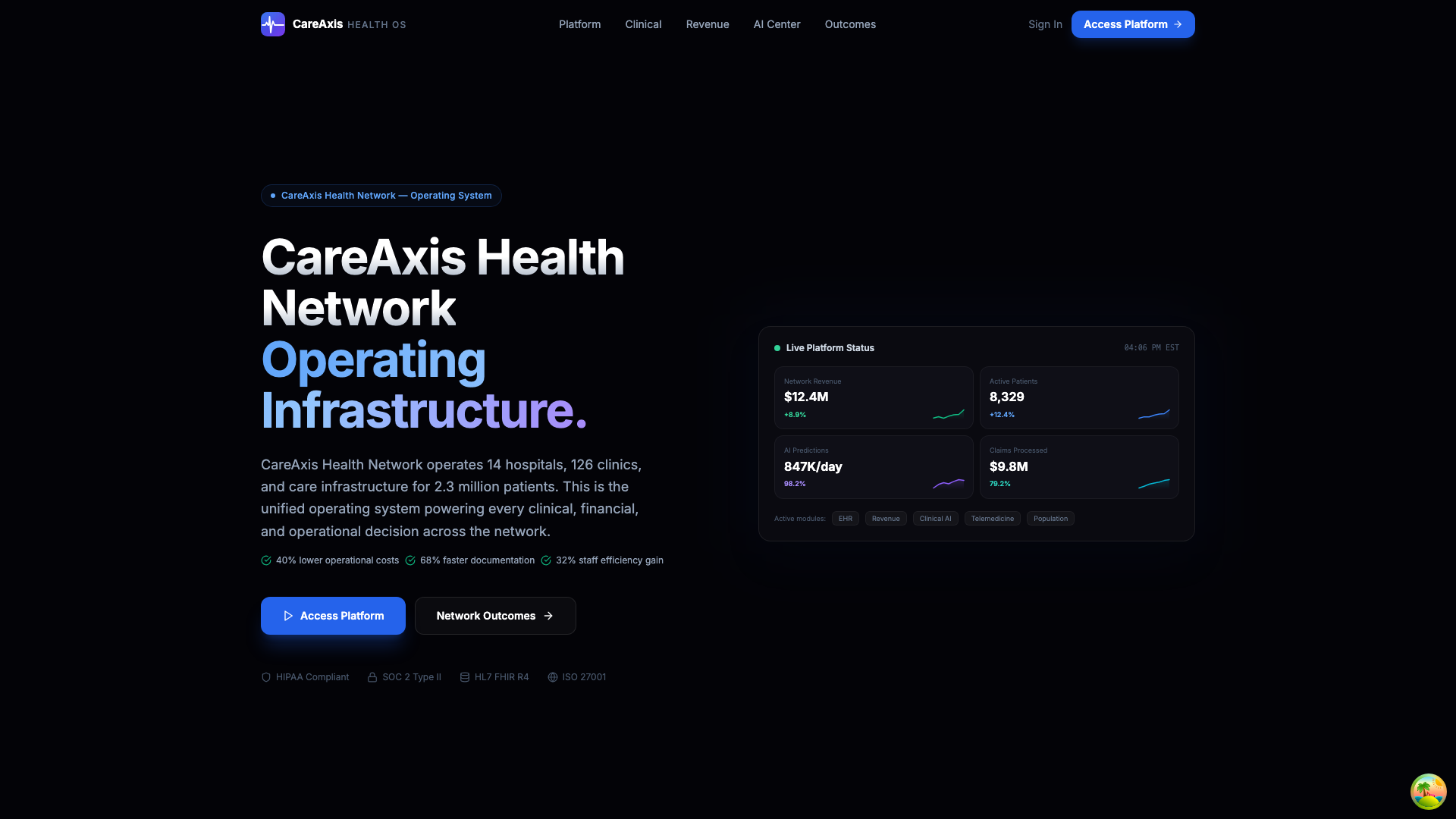
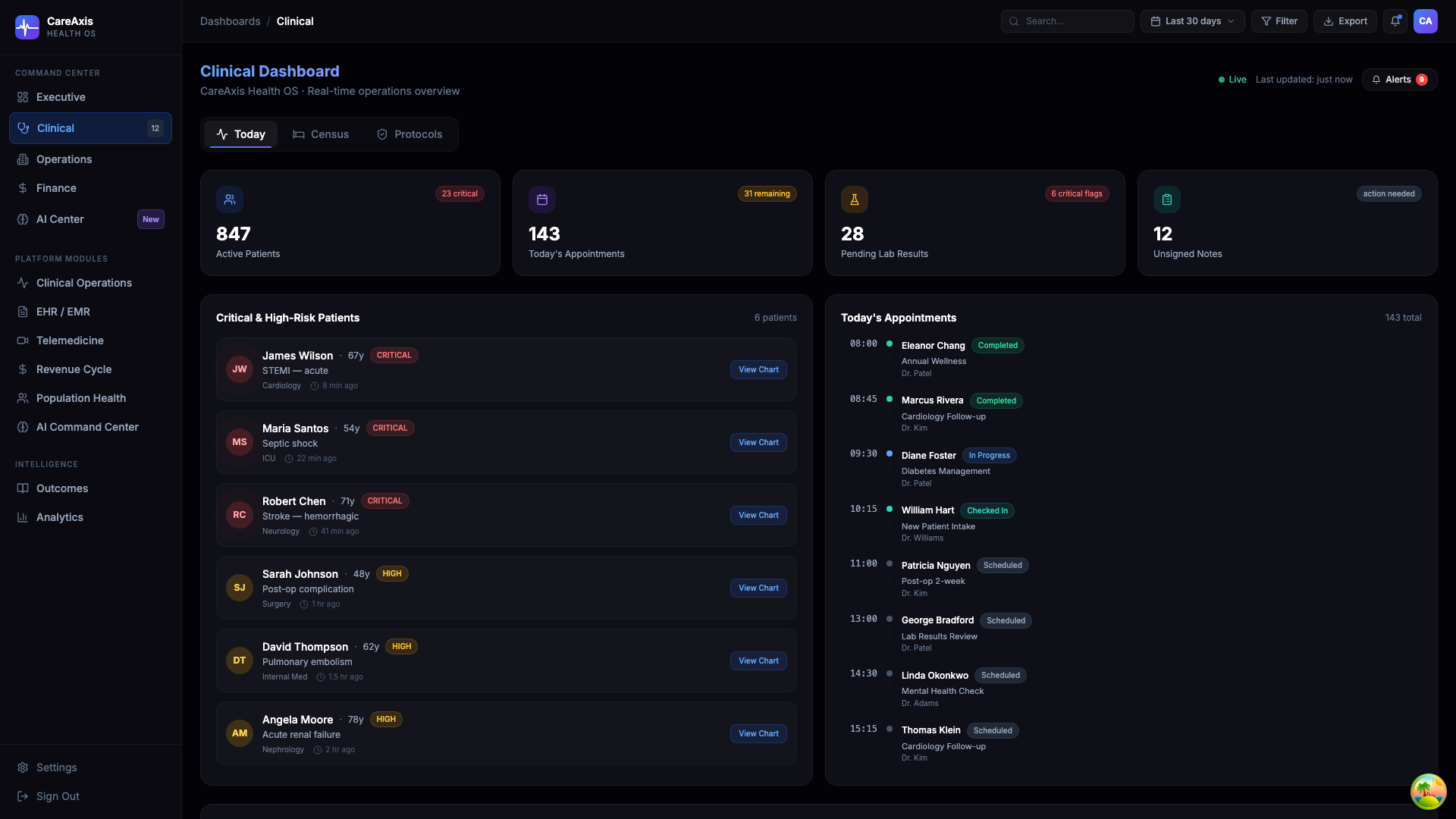
CareAxis Health OS
The enterprise healthcare operating system we engineered for a regional health system — unifying clinical workflows, telemedicine, revenue cycle, and population health in a single HIPAA-compliant platform.
60%
IT Complexity Reduced
40%
Admin Time Saved
28%
Collections Improved
HIPAA
Compliant
Related Services
Explore Related Services
Healthcare AI Solutions
Clinical AI for decision support and documentation.
AI Development
AI systems embedded in clinical and operational workflows.
Custom Software Development
Bespoke clinical and population health platform engineering.
Machine Learning Development
Predictive models for clinical and operational intelligence.
AI Automation Services
Automated prior auth, scheduling, and claims processing.
Generative AI Development
Ambient documentation and clinical knowledge systems.
CareAxis Health OS
See how we built an enterprise healthcare OS: HL7 FHIR, Epic API integration, telemedicine, and revenue cycle in one platform.
Technologies
Related Technologies
7 technologies · 6 categories
FAQ
Common Questions
HIPAA compliance is addressed at every level — architecture (PHI encryption, access controls, audit logging), development practices (secure coding standards), and deployment configuration. We produce HIPAA compliance documentation as a deliverable.
Yes. We have delivered integrations with Epic, Cerner, Meditech, Allscripts, and athenahealth using HL7 v2, FHIR R4, and vendor-specific APIs. EHR integration requires vendor coordination for sandbox access and interface activation.
FHIR (Fast Healthcare Interoperability Resources) is the current standard for healthcare data exchange. CMS interoperability rules require FHIR R4 compliance — making FHIR-native architecture a compliance requirement, not just a best practice.
Yes. We build HIPAA-compliant telehealth using encrypted WebRTC, PHI-safe session recording controls, signed consent management, audit logging, and BAA-compliant cloud infrastructure.
Focused applications like patient portals typically deploy in 12–18 weeks. Complex clinical platforms with multi-EHR integration and clinical validation range from 24–48 weeks.
Yes. We have delivered population health management platforms, care coordination tools, and analytics systems for ACOs, PCMHs, and value-based care programs — covering risk stratification, care gap identification, and shared savings tracking.
Yes. We develop HIPAA-compliant mobile apps for iOS and Android with offline capability, MDM compatibility, biometric authentication, secure data storage, and session timeout controls.
Clinical UX requires clinical context expertise. We engage end-user clinicians in requirements gathering, prototype review, and UAT — validating workflows match real clinical work patterns rather than developer assumptions.
We deploy on AWS HIPAA-eligible services, Microsoft Azure HIPAA, and Google Cloud Healthcare API — all offering BAA coverage. Infrastructure is configured with PHI encryption, access logging, and network segmentation.
For software meeting FDA Software as a Medical Device or clinical decision support criteria, we implement 21 CFR Part 11-compliant change controls, validation documentation, and risk management documentation aligned with IEC 62304.
Work With Halkwinds
Build Healthcare Software That Clinicians Trust and Regulators Accept
Halkwinds delivers healthcare software with HIPAA compliance, EHR integration, and clinical workflow design built in from the start.
Architecture. Engineering. Scale. — Built by Halkwinds Product Engineering.